
A cut at home makes families worried for one reason: it is hard to know if it is getting better or if something is wrong. A surgical cut looks red, on day two. Is that okay. Is it the start of an infection? A pressure sore seems smaller but smells different. Is it. Is it a sign of trouble?
The honest truth is that wound healing happens in a pattern and once you understand the pattern you can look at a wound the way nurses do. At Confiable Home HealthCare our nurses take care of wound care at home in Pittsburgh for wounds, pressure injuries, diabetic ulcers and skin tears every day. Here are the four stages of healing what normal looks like at each stage. The clear signs that mean infection.
The Wounds Families Manage at Home
Not all wounds heal alike. These are the ones Pittsburgh families see most often:
- Surgical incisions — closed with stitches, staples, or strips after surgery. Usually the most predictable healers if kept clean and undisturbed.
- Pressure injuries — caused by sustained pressure and friction over bony areas (heels, tailbone, hips) in seniors who sit or lie in one position too long. These are graded by depth:
- Stage 1: Skin intact but red and not blanching when pressed
- Stage 2: Partial skin loss — looks like a blister or shallow open sore
- Stage 3: Full skin loss; fat may be visible, muscle and bone are not
- Stage 4: Deep loss exposing muscle, tendon, or bone — always nurse-managed
- Diabetic foot ulcers — open sores on the foot caused by poor circulation and reduced sensation. Small on the surface, sometimes deep underneath.
- Venous leg ulcers — shallow, weeping wounds near the ankle from poor vein circulation, often with swollen legs.
- Skin tears — thin senior skin torn by a bump, a fall, or even adhesive removal. Common, painful, and frequently underestimated.
Whatever the type, all of them pass through the same four stages below — the difference is speed, and how much can go wrong along the way.

Stage 1: Hemostasis Stopping the Bleed (Minutes to Hours)
The moment skin is broken the body starts to seal the wound:
- Blood vessels. Platelets gather to form a clot.
- A scab forms over the surface as the clot dries.
- For an incision the edges are held together with stitches, staples or strips and a light dressing covers the area to protect it.
What normal looks like: Bleeding stops quickly. A small amount of fluid or fluid with a little blood on the dressing in the first 24 hours is expected.
Not normal at this stage: Bleeding that soaks through dressings again and again or an incision that opens up. Both need a call, to the surgeon the day.
Stage 2: Inflammation Cleaning the Wound (Days 1 to 4)
I have seen families think this is infection.
This is the stage that families often mistake for infection. White blood cells flood the wound clean out bacteria and damaged tissue and set the stage for rebuilding. That work produces four signs:
- Redness around the wound edges
- Warmth in the surrounding skin
- Mild swelling
- Pain or tenderness which should peak around day 2 and then ease
What normal looks like: Redness stays close to the wound edges. Swelling is modest. Pain improves a little each day after day 2. Any drainage is thin and clear or pale yellow.
The key rule of this stage: normal inflammation improves. Infection worsens after day 2 or 3. Hold that thought because infection is the most useful distinction, in this entire guide.
Stage 3: Proliferation Rebuilding (Days 4 to 24)
Now the construction phase is happening:
- Granulation tissue forms. Tissue that looks pink or red and slightly bumpy like the surface of a raspberry. This is healthy and what nurses want to see
- New blood vessels grow in giving the tissue its rich color
- The wound edges begin pulling inward; the wound visibly shrinks
- New skin starts creeping across the surface from the edges
What normal looks like: The wound gets measurably smaller over one to two weeks the base stays pink-red and moist and pain keeps fading.
Not normal at this stage: The wound stalls at the size, for two weeks the base turns pale, grey or dark or the edges start curling or separating.
Stage 4: Maturation — Strengthening (3 Weeks to 1–2 Years)
The final stage runs far longer than most families expect:
- Collagen in the new tissue reorganizes and strengthens
- The scar flattens, softens, and fades from pink toward the normal skin tone
- The repaired skin eventually regains up to about 80% of its original strength — never quite 100%
What normal looks like: A closed wound that slowly looks less angry over months. Gentle scar care and sun protection help, and the area should be treated as fragile long after it looks healed.

How to Recognize Infection: The 9 Warning Signs
Compare what you see against this list. One or more of these means the wound needs professional attention promptly:
Call the doctor or treating nurse the same day for spreading redness, pus, new odor, increasing pain, or a wound that reopens. Seek urgent care immediately for fever with chills, red streaks moving away from the wound, rapid swelling, or a wound on the foot of a person with diabetes that looks worse in any way — diabetic foot infections escalate faster than families expect, which is why our diabetes care services in Pittsburgh treat any foot wound change as same-day urgent.
Who Is at Higher Risk of Infection and Slow Healing?
- People with diabetes — high blood sugar impairs circulation, immunity, and sensation, so wounds are both more likely and easier to miss
- Poor circulation — arterial or venous disease starves tissue of the blood supply healing requires
- Seniors on steroids or immune-suppressing medication
- People who are bedbound or chair-bound — pressure adds a second injury on top of the wound
- Poor nutrition — healing tissue is built from protein; seniors eating little protein heal measurably slower
- Smokers — nicotine constricts blood vessels and delays every stage above
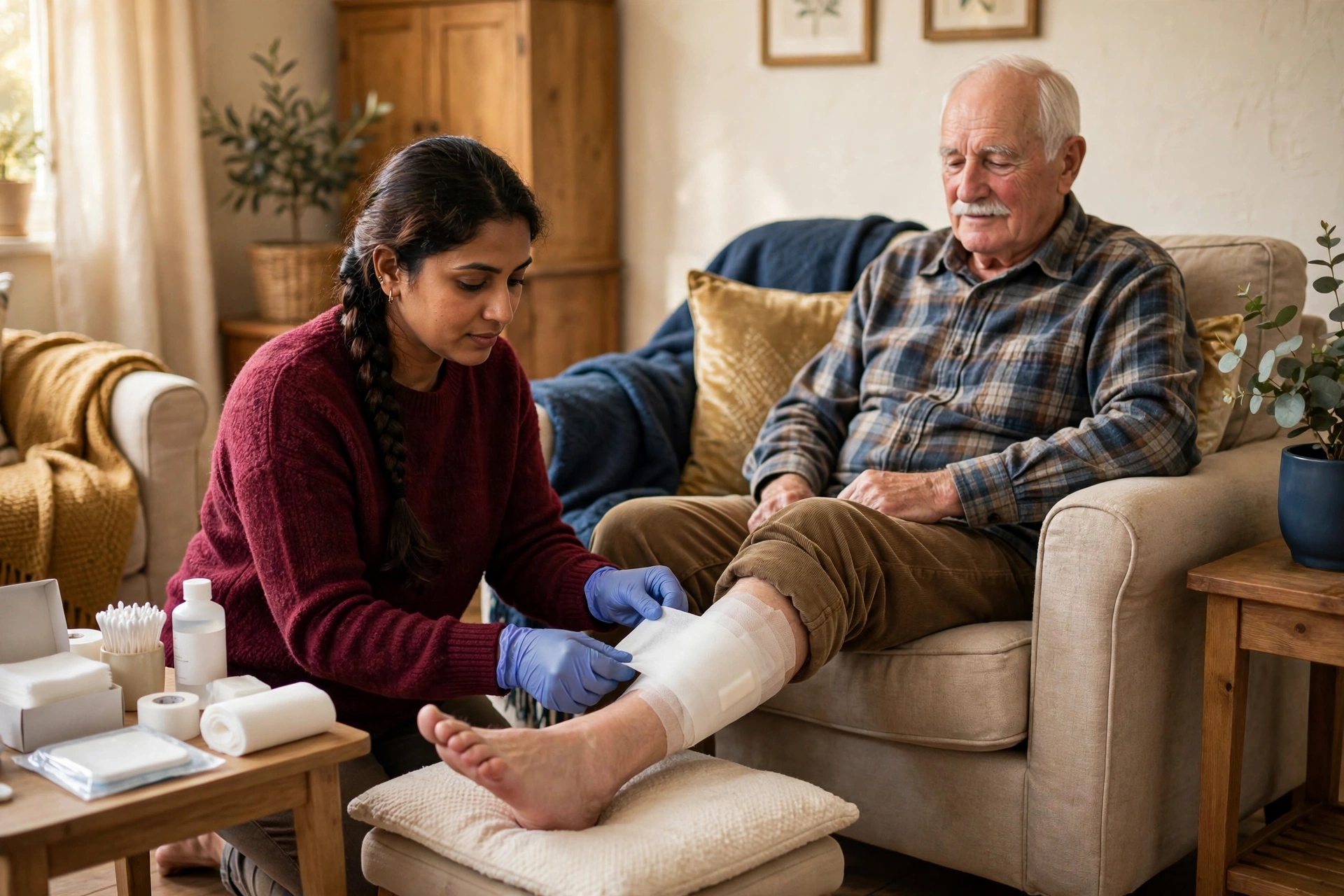
For these patients, home wound care should not be improvised. Our skilled nursing services in Pittsburgh provide nurse-led dressing changes, measurements, and photo-documented progress checks, so deterioration is caught by trend, not by crisis.
Home Care Rules That Protect a Healing Wound
- Wash hands before and after each dressing change. Hand hygiene stops wound infections at home.
- Follow the dressing schedule you were given. Not often not less. Every unnecessary change disturbs tissue on the wound; every missed change leaves a saturated dressing against the skin.
- Keep the wound clean and moist. Modern practice is not to dry the wound out. Use the products the nurse or surgeon specified.
- Skip. Alcohol. They damage the wounds granulation tissue. They belong to an era of wound care.
- Note. Once or twice a week record the wounds size, drainage amount, color and odor in a log. Or photograph it in the same light. Trends show what a single glance cannot.
- Offload pressure. For heel, sacral and foot wounds repositioning and pressure relief are not just comfort measures; they are the treatment of the wound.
- Feed the healing. Provide protein at every meal drink enough water and keep blood sugar controlled for diabetic patients. Ask the doctor before adding supplements. Feed the healing of the wound.
- Watch the dressing, not the wound. Sudden increases in drainage changes in color or early soaking through signal that the wound is speaking between changes.
Many of our wound patients arrive after a hospital stay when the incision is new and families feel least confident. Pairing wound care with post-hospital care in Pittsburgh covers the whole recovery. Medications, mobility, meals and the wound. Under one coordinated plan.
Frequently Asked Questions
How long does a wound take to heal?
Surface wounds and well-closed surgical incisions typically close within 2 to 4 weeks; deeper wounds take longer, and the strengthening stage continues for months afterward. Wounds in people with diabetes or circulation problems can take considerably longer and need professional monitoring throughout.
Is some redness around a wound always a sign of infection?
No. Redness, warmth, mild swelling, and tenderness in the first 3 to 4 days are the normal inflammatory stage and usually mean healing is underway. Redness becomes a warning when it spreads, intensifies after day 3, or arrives with pus, odor, fever, or increasing pain.
What does healthy new wound tissue look like?
Healthy granulation tissue is pink to red, moist, and slightly bumpy. Pale, grey, dark, or black tissue is a warning sign, as is tissue that looks dry and shriveled. When in doubt, have a nurse look — this judgment is exactly what home wound care visits are for.
Can a family member change wound dressings at home?
For simple wounds, yes, after being taught the technique, with strict hand hygiene and the specified supplies. Complex wounds — deep, draining heavily, on a diabetic foot, or showing any infection sign should be handled by a nurse. Medicare’s home health benefit covers skilled wound care for qualifying patients; families unsure about coverage can ask our team during an assessment.
What should we do the moment we suspect infection?
Do not wait for the next scheduled visit. Note the signs you are seeing, take the senior’s temperature, and call the doctor, surgeon, or treating nurse the same day. Early wound infections are usually handled with prompt treatment and dressing changes; delayed ones are what become hospitalizations.
Conclusion
Wound healing follows four stages: hemostasis, inflammation, proliferation, maturation. Each stage shows an appearance that is easy to notice.
Infection stops the pattern. Of getting better day by day an infected wound grows, hurts more drains more and smells worse.
Learn each stage of wound healing watch the pattern of the wound and act on the warning signs of infection the day.
That combination of watching wound healing and acting on infection signs keeps a healing wound at home from becoming an emergency.
If you are caring for a wound at home, in Pittsburgh. Are not sure whether the wound is healing or infected contact Confiable Home HealthCare today.