
The call usually comes after the scare not before it.
A daughter in Squirrel Hill told us her mother had “slipped a little” in the tub on Tuesday. Nobody was hurt nothing was. That is exactly why she called. Because she understood what Tuesday could have been. By Friday one of our assessors from Confiable Home HealthCare was standing in that bathroom with a tape measure, a flashlight and a simple question: if we walk this room the way your mother uses it at 2 where does it try to hurt her?
That walk. Eight stops in the order a senior actually moves. Is the whole of a bathroom safety assessment and it is the same one behind our fall prevention services in Pittsburgh. Here it is, the way it really happens. Keep a running score as you read; every hazard has points. At the end the total tells you the truth, about the room.
It Starts in the Bedroom, Not the Bathroom
Stand at the bed. Now walk to the bathroom the way she does at night. Half asleep, in the dark in a hurry.
That hallway in Squirrel Hill was pitch black. There was a laundry basket sitting in it. Dark route (+2). Obstacle on the path (+2). Then the bathroom door: it stuck on its frame. Only opened three-quarters of the way and the little privacy lock could not be opened from outside. A woman who falls against that door has locked her rescuers out. (+1 For the door +2 for the lock.)
We had not reached the bathroom yet. The score was already 7.
The fixes here cost nothing: motion-sensor night lights, down the hallway the basket moved, a privacy lock that a coin or a fingernail can open from the hall. An evenings work.
Then the Light, the Floor, and the Sock Test
Flip the switch. In this bathroom one dim bulb hangs over the mirror and a window that is too small to matter. Everything looks soft and gentle which simply means that the person cannot see water on the tile. (+1.) The tile is glossy, beautiful in the showroom but treacherous when wet. (+2.) The bath mat beside the tub is pretty, woven and slides freely on the floor because its rubber backing has worn out years ago. A mat that slides is worse than no mat all – it promises grip and then betrays the person. (+2.)
Here is a professional trick, free of charge: the sock test. Walk the floor in your socks. If you slide so does the person – except the person is barefoot at night holding a towel.
A rubber-backed mat brighter bulbs and an anti-slip treatment, on the tile removed this worry from the list.
The Tub Is Where Bathrooms Hurt People
Now the main event. I watch her get in—or rather I watch where her hands go.
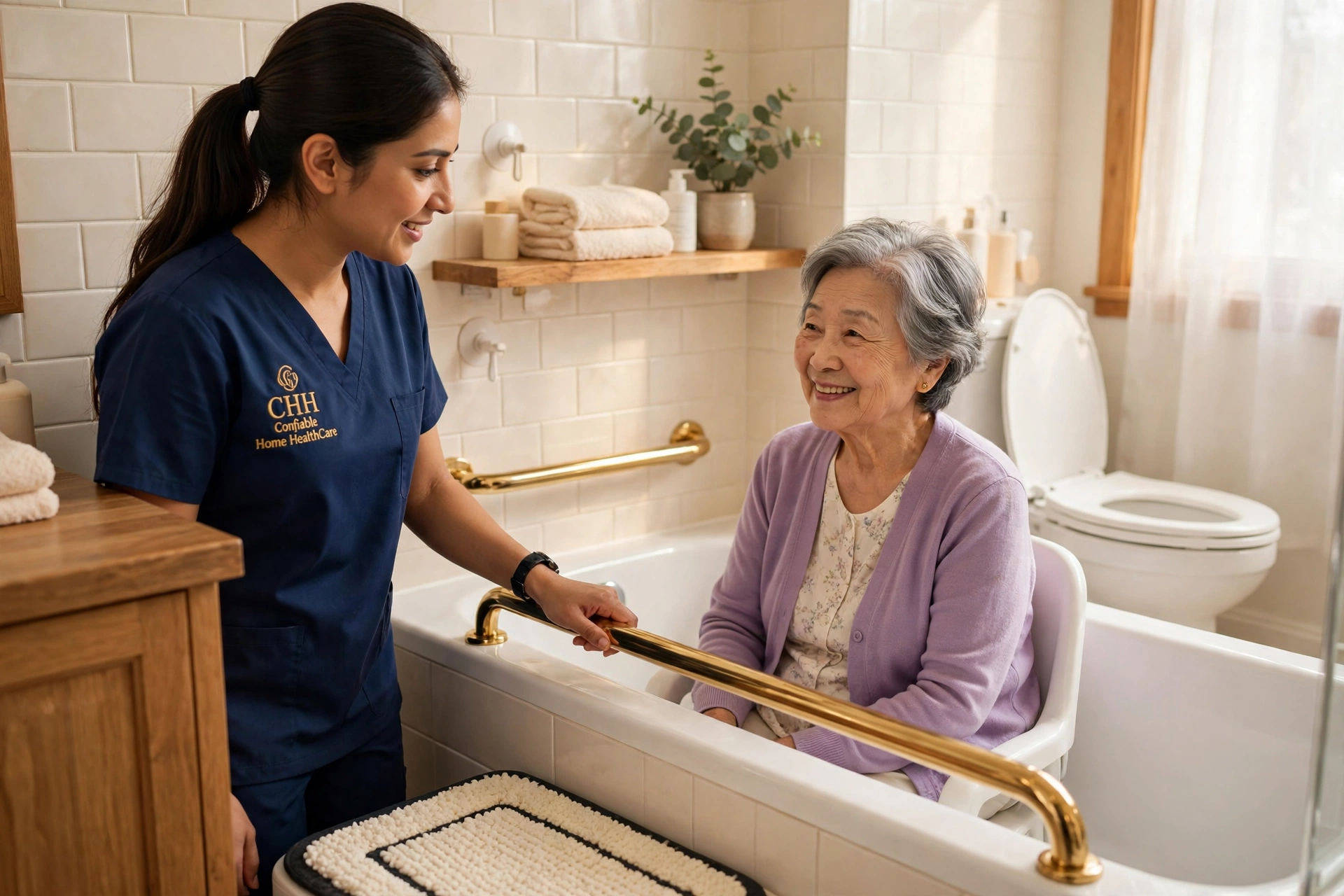
In this house she climbed over a tub wall sixteen inches high (+2). Across she balanced on one wet leg and grabbed the towel bar to steady herself. The assessor reached up took hold of that bar and pulled. It flexed. These bars are screwed into tile and hoped to hold; they are rated for a hand towel, not for a falling woman. Under her weight mid-fall it would have come out of the wall in her hand. (+3. The dangerous single habit in the room.)
There was no shower chair (+2) no handheld shower, a fixed shower head she had to stand under (+1). The taps were only reachable by leaning into the tub and guessing the temperature (+1).
The fix is not glamorous. It works completely. A shower chair set at the height a handheld shower so she can bathe while sitting and— for tub users— a transfer bench that turns the climb into a slide across. In the run a walk-in shower removes this entire section from the assessment. Our product guide on bathroom safety for seniors explains the options, in detail.
The Grab Bar Interview
Every bathroom claims to have grab bars. The assessment asks three questions: where, how high and show me.
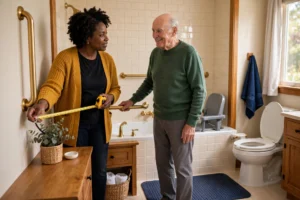
Where: there should be one grab bar inside the shower for standing support one grab bar at the entry where the transfer happens and one grab bar by the toilet. This bathroom had one grab bar. A grab bar, in the wrong place. Missing shower grab bar (+3) missing entry grab bar (+2) missing toilet grab bar (+2).
How high: horizontal grab bars belong 33 to 36 inches above the floor. The height where a hand actually lands when balance goes. The grab bar was at shoulder height installed by a meaning son-in-law where it looked right. The grab bar was a towel bar with marketing.
Show me: the assessor gripped the grab bar and pulled hard. The grab bar moved. A grab bar that movess not equipment; it is decoration with a false promise. (+3.) Real grab bars are anchored into wall studs or with rated hollow-wall anchors. Hold at least 250 pounds without a whisper. Suction-cup grab bars, whatever the packaging says, are travel accessories. They let go silently on the worst possible day.
The grab bar installation is the one paying a professional to install. The grab bar installation is also not coincidentally, the highest-value change, in the room.
The Toilet Tells the Truth About Leg Strength
“Sit down ” the assessor said, “. Then stand up. Show me how you do it.”
She lowered herself the twelve inches. Then dropped the last three. Getting up she pulled on the edge of the sink with both hands. That drop and that pull are the toilet revealing what her legs can no longer do quietly. A regular toilet stands fifteen inches high; comfort height is seventeen to nineteen and those two inches are the difference between standing and climbing. Low seat (+2) rising off the sink (+2). The toilet paper meanwhile was in a holder that forced her to twist and reach behind. A movement on a low seat that has ended more than one seniors independence. (+1.)
A raised seat gives the height today for little money. The comfort-height toilet is the answer.. The toilet paper is, within easy forward reach. Thirty seconds, zero dollars.

The Sink, the Shelf, and the Quiet Hazards
The rest of the walk is faster. It is mainly about habits that the room has taught her.
All items she used every day. Medication, glasses case, denture cup. Were on a shelf or deep in a low cabinet so each morning began with reaching up or bending double at the sink the two movements most likely to make an older person feel light-headed. (+1.) She leaned on the sink while brushing her teeth; pedestals are plumbed, not braced and they are not built to hold a person. (+1) A space heater sat two feet from the tub plugged into an outlet with no GFCI protection. Not a fall hazard, strictly speaking,. The assessment is about the room and the room had a live electrical risk, beside the water. (+2) And there was nowhere to sit; she stood through her routine tiring the legs that the tub transfer would soon demand. (+1)
Waist‑height storage, a sturdy stool and GFCI protection were confirmed. Small items. They add up to a room that quietly works against her.
Last, the Water Itself
The assessor turned on the tap waited and placed a thermometer under the hot tap: 132 degrees. I watched the number rise. Felt a chill.
I knew that Senior skin is thinner slower to feel heat and slower to move from the hot tap. Above 120°F (49°C) a bath becomes a scald risk.. The temperature at the hot tap can jump without warning when a toilet flushes somewhere in the house. (+2 For the heat +1 because Senior skin did swing, +1 for round taps Senior skins arthritic hands can barely grip.)
The fix lives in the basement not the bathroom: water heater set to 120°F. One step further is an anti-scald valve, at the shower and lever handles skins arthritic hands can actually work. I plan to install the -scald valve next week.
The Half of the Assessment That Is Not About the Room
Here is what the tape measure cannot score and what many families skip: the seniors own body and her medicine cabinet step into the bathroom together.
Warm water makes blood vessels widen. Blood pressure medication does the same. Put them together. Finish with a quick stand at the end of a long bath and you create orthostatic hypotension. Orthostatic hypotension is a drop in pressure that makes a senior grey out while moving, in the wettest hardest room in the house. Sedatives, sleep aids and some diabetes medications add the danger.
The dangerous bathroom in Pittsburgh may belong to a senior whose room scores a perfect zero, twenty minutes after her evening pills.
So the assessment ends with three questions for her doctor or pharmacist: Do any of her medications blood pressure or cause dizziness? Have any doses changed recently?. Is the timing of her evening dose colliding with her bath?
Sometimes the value “bathroom fix” is moving a medication by two hours— a decision, for her clinician triggered by a family that knew to ask. Our medication management services in Pittsburgh exist for exactly this layer of safety.
For a senior with dementia, add one short chapter: contrast is safety. A white toilet against a white floor can disappear for a dementia brain; a colored seat fixes it. Mirrors sometimes frighten rather than help — if she is agitated by “the stranger in the bathroom,” cover it. Faucet markings stop meaning “hot” and “cold,” which makes the anti-scald valve non-negotiable. And the door lock from Step 1 reverses its meaning: it must never be able to trap her in — or lock a helper out.
The Score, Read Honestly
That Squirrel Hill bathroom had 34 points. The scale is not kind and it is not supposed to be:
- 0–4 risk. Keep the room as it is and check it again in six months
- 5–9, moderate risk. Fix the one-hour things this week and schedule the installations
- 10 and above high risk. This room is not safe for her alone today; she needs help when bathing until the big changes are done
Thirty-four made her daughter very nervous until the assessor split it into two groups. Group one, an afternoon job: night lights, the mat, the chair, the shelf, the water heater the toilet paper. All done by Sunday, no cost. Group two a scheduled visit: three grab bars that are fixed into the walls and a higher toilet seat. Two groups and the scariest room in her mothers house became the one, in two weeks.
So the budget question solves itself in levels:
That is the pattern in almost every Pittsburgh home we assess: the risk is real, and most of it is cheap. What it is not is optional to look at.
One more thing the score cannot see: the senior herself. A flawless bathroom still loses to legs that are weakening month by month, which is why this assessment sits beside the strength and balance work in our home physical therapy plan to reduce fall risk and, for the daily activities themselves, occupational therapy services in Pittsburgh. And on the days when even a fixed bathroom is more than she should face alone, personal care services in Pittsburgh put a trained aide beside the transfer — which is what that daughter arranged for the two weeks before the bars went in. Our home safety checklist and planning resources extend the same walk to the rest of the house.
Questions Families Ask Us on This Walk
Where exactly do the grab bars go?
One horizontal bar on the shower’s main wall, 33 to 36 inches off the floor. One on the wall with the taps. One vertical bar at the entry, right where the hand lands mid-climb. One beside the toilet. Then the only test that matters: take hold and pull like you mean it. Silence and stillness pass. Anything else fails.
She refuses the shower chair. Says it makes her feel old.
Then start with the bars and the handheld shower, and let the chair arrive as “something the nurse left, just try it once.” Pride is a real clinical factor, and it bends more easily than it breaks. Most seniors who try seated bathing keep it — it is warmer, steadier, and far less frightening than the climb.
Is a raised toilet seat enough, or do we need the new toilet?
The seat is enough for most people, most of the time — two to four extra inches, installed in minutes, removed in seconds. The comfort-height toilet earns its cost when the seat’s clamps annoy, when two seniors share the bathroom, or when the long-term plan is aging in this house for a decade.
How hot is too hot, honestly?
One hundred and twenty degrees at the tap. Not at the heater’s dial — at the tap, with a kitchen thermometer, after the water has run a minute. It takes ninety seconds and it is the cheapest test on this entire page.
Should she wear a medical alert button in the bathroom?
Yes — and in the shower specifically. The bathroom is where seniors are least likely to be heard and least able to reach a phone. A waterproof pendant or wrist button worn during bathing closes the one gap a perfect room cannot: the gap between falling and being found.
How often should we redo this walk?
Twice a year, and the morning after anything changes: a fall anywhere in the house, a hospital stay, a new medication that touches blood pressure or balance, a parent who suddenly seems weaker. Bathrooms do not change much. The people using them do — that is what you are re-assessing.
Can someone just come and do this for us?
Yes. That is rather the point of the story you have been reading.
Conclusion
Nobodys mother falls because a family didn’t care. She falls because the room was never walked. Slowly, at night in socks with a tape measure and a willingness to pull hard on the bars.. Because nobody asked what her evening medication does to her blood pressure in a hot bath. Do that walk, ask that question and plan for the fall you hope never comes and the bathroom goes back to being what it should be: the ordinary room in the house.
If you would like this assessment done professionally in your loved ones Pittsburgh home contact Confiable Home HealthCare today. Call us at (412) 530-3192. We will walk the bathroom with you score the risks and build the fix list in the right order.
Confiable Home HealthCare: bathrooms and steadier seniors, across Pittsburgh.